
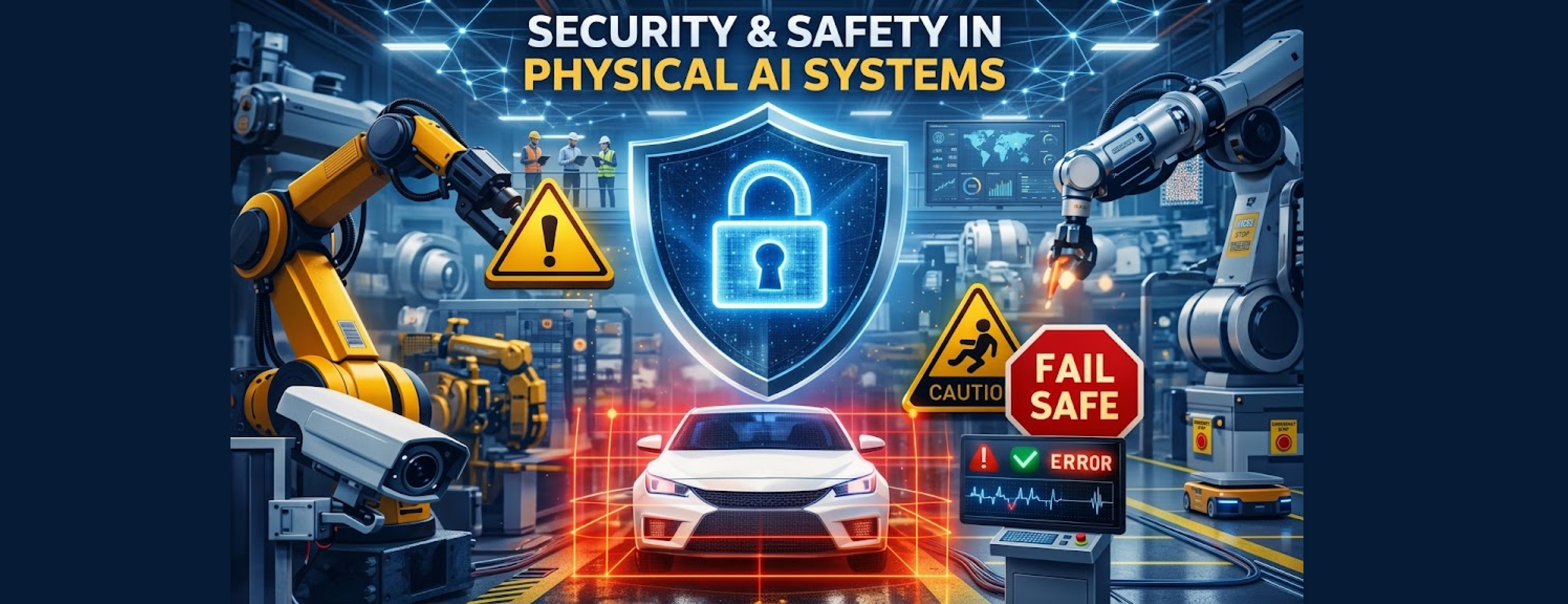
As artificial intelligence moves beyond software and into the physical world, the stakes change dramatically. Systems that once generated text or analyzed images are now interacting with machines, infrastructure, and real environments. This shift—often called Physical AI—introduces a new level of responsibility. When AI controls or influences physical processes, mistakes are no longer just software bugs; they can translate into real-world damage, safety risks, and operational disruptions.
When AI Meets the Physical World
Traditional AI systems operate in digital environments. If a chatbot generates a wrong answer, the impact is typically limited to misinformation or user frustration. In contrast, physical AI systems interact with sensors, cameras, robots, and industrial systems. These systems may control or inform decisions that affect equipment, facilities, and people.
Consider a few examples:
- An AI-powered robotic arm misidentifies an object and damages equipment.
- A computer vision system incorrectly classifies defects in a manufacturing pipeline, allowing faulty products to pass inspection.
- An automated warehouse system fails to detect an obstacle, creating a safety hazard for workers.
In these environments, AI errors can lead to damaged equipment, safety hazards, or operational failures. As a result, deploying AI in physical systems requires a significantly higher bar for reliability and safety.
The Need for AI Safety Infrastructure
To safely operate physical AI systems, organizations must implement multiple layers of protection around the models themselves. These layers form a safety and observability framework that ensures the system behaves predictably even when models encounter unexpected situations.
Key components of this infrastructure include:
1. Monitoring and Observability
Monitoring provides visibility into how AI systems behave in production. It allows teams to track:
- inference latency
- prediction confidence
- model drift
- anomaly detection
In physical AI deployments—such as automated inspection tunnels or industrial robots—monitoring helps identify when the system starts producing unusual or unreliable outputs. Early detection allows operators to intervene before problems escalate.
2. Guardrails and Validation Layers
Guardrails act as protective boundaries around AI decisions. These mechanisms ensure that outputs from the model meet predefined rules or safety criteria before being accepted.
Examples of guardrails include:
- confidence thresholds for predictions
- schema validation for structured outputs
- rule-based sanity checks
- anomaly detection filters
In many systems, AI outputs are not used directly but instead pass through validation layers that confirm the results are safe and consistent with operational constraints.
3. Evaluation Pipelines
Evaluation pipelines continuously test the performance of AI models against known datasets or real-world feedback loops. These pipelines measure key metrics such as:
- accuracy and recall
- false positives and false negatives
- system latency
- operational reliability
Regular evaluations ensure that models remain effective as conditions change. In production systems, evaluation pipelines often run automatically whenever a new model or configuration is deployed.
4. Fail-Safe Mechanisms
Perhaps the most important safety feature in physical AI systems is the presence of fail-safe mechanisms. These mechanisms ensure that when the AI system fails—or becomes uncertain—the system can safely degrade or fall back to alternative behavior.
Examples include:
- human-in-the-loop overrides
- fallback algorithms or rule-based systems
- system shutdown triggers when anomalies are detected
- redundancy through multiple models or sensors
Fail-safe design ensures that AI failures do not escalate into operational failures.
Why Physical AI Demands Higher Standards
In traditional software systems, errors may result in inconvenience or downtime. In contrast, physical AI systems operate within environments where mistakes can affect real assets and human safety. This means the engineering standards for these systems must resemble those used in critical infrastructure and industrial control systems.
Deploying AI responsibly in these environments requires more than just accurate models. It requires robust operational infrastructure that continuously monitors, validates, and safeguards the system.
Building Trustworthy Physical AI
As AI continues to expand into robotics, manufacturing, autonomous systems, and industrial automation, the need for secure and reliable AI architectures will only grow. Companies that succeed in this domain will not simply build better models—they will build complete safety frameworks around them.
Monitoring, guardrails, evaluation pipelines, and fail-safe mechanisms together form the foundation of trustworthy physical AI systems. Without these safeguards, even the most advanced models can become liabilities rather than assets.
In the era of physical AI, safety is not an optional feature—it is a core architectural requirement.