
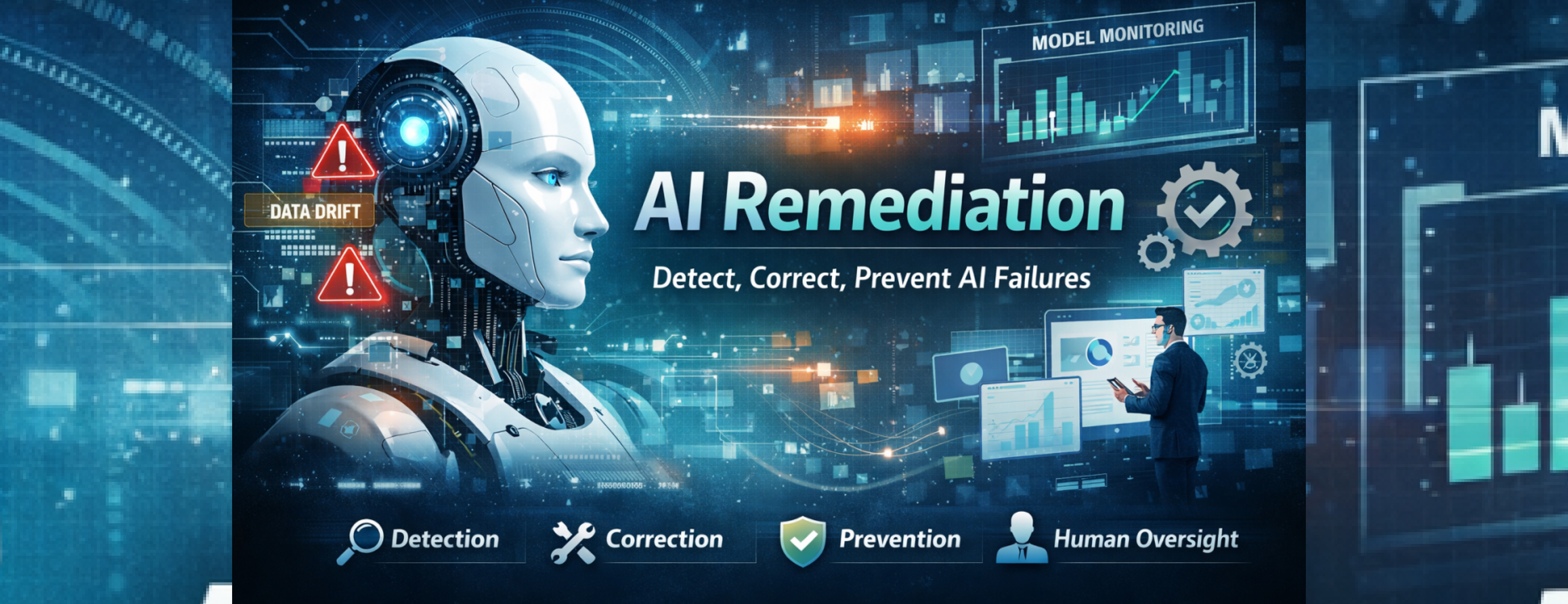
Artificial Intelligence is rapidly moving from experimentation to production. Organizations are deploying AI systems to make decisions about finances, hiring, healthcare, fraud detection, security, and autonomous operations. While these systems offer enormous efficiency gains, they also introduce a critical challenge: AI systems make mistakes.
Unlike traditional software bugs, AI errors are often probabilistic, data-driven, and hard to diagnose. This is where AI remediation becomes essential.
AI remediation refers to the process of detecting, correcting, and preventing failures in AI systems after they occur in production.
Why AI Remediation Matters
AI systems operate in environments that constantly change. Data distributions evolve, user behavior shifts, and real-world conditions differ from training environments.
This leads to several risks:
Model Drift: Over time, the data the model sees in production diverges from the data it was trained on.
Incorrect Predictions: Models may hallucinate, misclassify, or fail to recognize edge cases.
Safety Failures: In systems controlling physical processes—robots, vehicles, industrial systems—mistakes can cause real-world damage.
Compliance Violations: AI models can inadvertently process sensitive data, generate harmful content, or violate regulatory rules.
Without remediation, these problems compound silently.
AI systems do not fail loudly like traditional software. They degrade gradually.
The AI Remediation Lifecycle
AI remediation is not a single fix. It is a continuous operational loop.
1. Detection
The first step is identifying when something goes wrong.
Common detection mechanisms include:
- Model monitoring dashboards
- confidence score thresholds
- data drift detection
- anomaly detection systems
- human feedback loops
For example, in a computer vision system detecting vehicle damage, sudden spikes in false positives might indicate that lighting conditions or camera angles have changed.
2. Diagnosis
Once a failure is detected, the next step is understanding why.
Diagnosis involves examining:
- input data distributions
- model outputs
- intermediate features
- attention maps or embeddings
- system logs
Modern AI observability tools allow teams to trace which data patterns triggered incorrect predictions.
For example:
- A fraud detection model may start misclassifying transactions because a new payment platform introduced different metadata.
- A vision model may fail because vehicles now appear in different orientations.
3. Correction
After diagnosis, the system must be corrected.
There are several remediation strategies:
Model retraining: Update the model using newly labeled data.
Rule-based guardrails: Introduce deterministic checks that override model outputs when certain conditions are met.
Prompt corrections: For LLM systems, adjust prompts or add system instructions.
Human-in-the-loop review: Flag uncertain predictions for manual verification.
Fallback systems: Use secondary models or rule engines when the primary model fails.
In many enterprise systems, remediation combines machine learning with deterministic logic.
4. Prevention
The final step is ensuring the same issue does not recur.
Preventive mechanisms include:
- automated retraining pipelines
- dataset versioning
- continuous evaluation benchmarks
- A/B testing for model updates
- safety policy enforcement
Organizations mature their AI systems by moving from reactive fixes to proactive resilience.
AI Remediation in Real Systems
Consider a computer vision pipeline for object detection.
A typical remediation architecture may include:
- Object detection model identifies an object.
- Segmentation model identifies object regions.
- LLM or reasoning model explains severity.
- Rule engine validates outputs.
If the system detects impossible scenarios—such as an object in mid-air—the rule engine triggers remediation:
- Flag prediction
- Request human review
- Retrain the model using corrected annotations
This layered approach ensures AI errors are caught before impacting downstream decisions.
Key Components of an AI Remediation Platform
Modern AI platforms include several remediation-focused capabilities:
AI Observability: Monitoring model behavior in real time.
Data Quality Pipelines: Detecting corrupted or out-of-distribution inputs.
Human Feedback Systems: Capturing corrections from users and experts.
Automated Retraining Pipelines: Updating models as new data becomes available.
Policy and Safety Layers: Guardrails that prevent harmful outputs.
Together, these components create an AI reliability stack.
The Future of AI Remediation
As AI systems grow more autonomous, remediation will become a core discipline—similar to site reliability engineering (SRE) in cloud infrastructure.
Future systems will include:
- self-healing AI pipelines
- automatic error clustering
- real-time model patching
- autonomous retraining agents
In other words, AI systems will increasingly repair themselves.
However, human oversight will remain essential, especially for high-stakes decisions.
Conclusion
AI remediation is the discipline that ensures AI systems remain reliable, safe, and trustworthy in production.
Building powerful models is only the first step. The real challenge is managing them once they are deployed.
Organizations that succeed with AI will not be those with the best models—but those with the best remediation systems.
Because in real-world environments, AI errors are inevitable.
What matters is how quickly and safely they are corrected.