
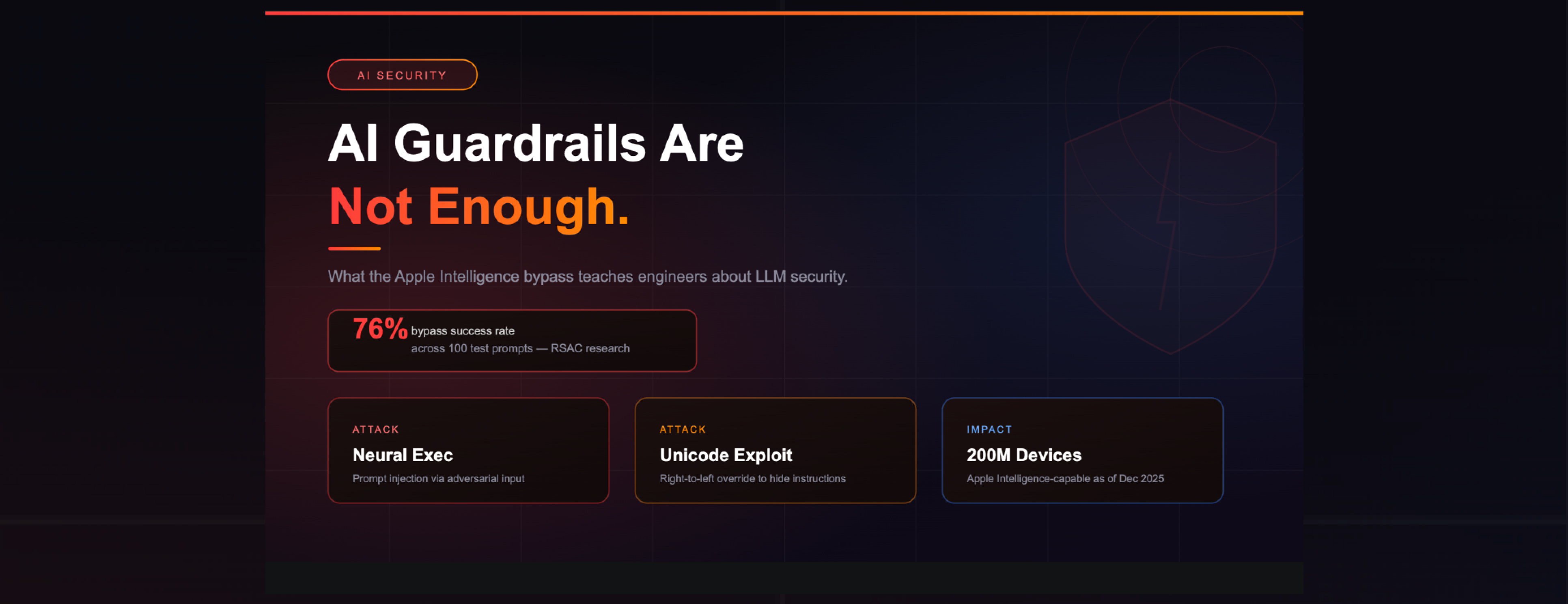
Apple Intelligence processes data on-device. It uses Private Cloud Compute for sensitive operations. It has content filters on both input and output. By most standards, it is one of the most security-conscious AI deployments in consumer technology.
Researchers bypassed it with a 76% success rate.
At RSAC, security researchers demonstrated how combining two techniques — Neural Exec prompt injection and Unicode manipulation — could force Apple's local LLM to produce offensive content or manipulate private data from third-party apps. The attack encoded malicious instructions backward, then used Unicode's right-to-left override character to render them correctly at inference time. The model followed the instructions. The filters never saw them.
Apple issued patches in iOS 26.4 and macOS 26.4. But the broader lesson isn't about Apple. It's about the state of AI security across the industry.
The Guardrail Problem
AI guardrails — content filters, safety classifiers, output monitors — are typically trained to recognize threats in a specific form. They are brittle by design. They look for patterns. Adversarial inputs are specifically engineered to break those patterns.
This is not a new problem. It is the same arms race that has defined web security for decades: SQL injection evolved into NoSQL injection, XSS evolved into DOM-based XSS, phishing evolved into spear phishing. Each time defenders built a wall, attackers found a gap in the material, not the design.
AI is following the same trajectory — only faster, because the attack surface is language itself, and language is infinitely malleable.
The two techniques used in the Apple research illustrate this clearly:
Neural Exec — Prompt injection using adversarially crafted inputs, sometimes described as "gibberish," that exploit the model's tokenization and attention mechanisms. The input looks meaningless to a human reviewer but carries executable meaning to the model.
Unicode manipulation — Using Unicode control characters (in this case, right-to-left override) to hide malicious content in plain sight. The text appears benign in any standard viewer. The model processes the underlying byte sequence and acts on it.
Neither technique is novel in isolation. Their combination, applied to a production AI system with a reported reach of 200 million capable devices, is what makes this research significant.
What This Means for Engineers Building on AI
If you are integrating LLMs into a product — whether through an API, an on-device model, or an AI SDK — the Apple research surfaces three concrete risks worth thinking through.
1. Input sanitization is not optional
The same principle that applies to SQL queries applies to LLM prompts: treat all external input as untrusted. Text arriving from third-party apps, user-generated content, web scraping, or document ingestion should be sanitized before it reaches the model. This includes stripping Unicode control characters, normalizing text direction, and validating encoding.
2. Output filters are a last line, not a first line
The RSAC attack succeeded in part because it targeted the gap between what the filter expected to see and what the model actually processed. Output filtering is a necessary layer, but it cannot be the only layer. Defense in depth — validating inputs, constraining system prompts, limiting model capabilities to what the use case actually requires — reduces the attack surface before output is ever generated.
3. On-device does not mean safe
A common assumption is that local model execution eliminates the risk of data exfiltration or manipulation. The Apple research challenges that assumption. On-device models are still models. They still process instructions. If those instructions are adversarially crafted, the execution environment is irrelevant.
The Structural Challenge
What makes AI security genuinely difficult is that the vulnerability is in the model's core capability — following instructions in natural language. You cannot simply patch instruction-following without degrading the product. Every safety measure is a constraint on the same mechanism that makes the model useful.
This is fundamentally different from traditional software security. A buffer overflow can be fixed by bounds checking. A prompt injection cannot be fixed by "check if the prompt is malicious" — that check is itself a language understanding task, susceptible to the same adversarial inputs.
The research community is actively developing more robust approaches: formal verification of model behavior, adversarial training on known attack patterns, constrained decoding that limits output to known-safe token sequences. None of these are solved problems. All of them are active areas of investment.
What This Means for the Industry
The Apple case is a signal, not an anomaly. As AI becomes embedded in operating systems, enterprise software, developer tools, and consumer apps, the attack surface scales with adoption. The researchers estimated 100,000 to 1 million users had installed apps potentially vulnerable to manipulation through this vector — before the patch.
Responsible deployment of AI systems now requires the same rigor applied to any other critical software component: threat modeling, penetration testing, vulnerability disclosure programs, and rapid patch cycles. The fact that Apple shipped a fix in iOS 26.4 and macOS 26.4 is evidence that this rigor is possible. The fact that the vulnerability existed in a production system at this scale is evidence that it is not yet the norm.
Engineers building on AI today are making security decisions that will affect users at a scale most software never reaches. The tools for getting this right are still maturing. The responsibility to use them isn't.
References
Apple Intelligence AI Guardrails Bypassed in New Attack — SecurityWeek https://www.securityweek.com/apple-intelligence-ai-guardrails-bypassed-in-new-attack/
OWASP Top 10 for Large Language Model Applications https://owasp.org/www-project-top-10-for-large-language-model-applications/