
Every AI classifier you've ever used ends with the same function: softmax. It converts raw logit scores into a probability distribution that sums to 1.0, making a model's output look clean, confident, and trustworthy.
But that trustworthiness is partly an illusion. And if you're deploying ML systems in production, you need to understand exactly how softmax can be exploited.
What Softmax Actually Does
Given a vector of raw scores z, softmax computes:
P(class_i) = exp(z_i) / sum(exp(z_j))The output always looks like probability — every value is between 0 and 1, and they all sum to 1. This is elegant for training. In adversarial hands, it's a surface to attack.
Attack Surface #1: The Overconfidence Problem
Feed a neural network an image of pure static. Ask it what it sees. It won't say "I don't know." It will say, "92% confident this is a tabby cat." Softmax cannot output uncertainty. It forces confidence. This means:
- Out-of-distribution inputs get confidently misclassified
- Attackers can feed your model complete garbage and get high-confidence, wrong answers
- Safety systems that rely on confidence thresholds are bypassable by design
This isn't a bug in your model — it's structural to softmax.
Real-world consequence: Medical AI systems, fraud detectors, and content moderation models can be fooled with inputs that look like noise to humans but land in a high-confidence region of the model's learned manifold.
Attack Surface #2: Adversarial Examples Through the Gradient
Softmax is differentiable. That's the point — it allows gradients to flow during training. But it also means an attacker with knowledge of your model can run gradients backwards to craft inputs that maximize the probability of any target class.
The Fast Gradient Sign Method (FGSM), PGD attacks, and their variants all exploit this. The math is simple:
x_adversarial = x + epsilon * sign(gradient of loss w.r.t. x)A pixel change invisible to the human eye can push a model from "98% dog" to "99% rifle." Softmax amplifies these perturbations because the exponential function is extremely sensitive to small logit shifts near the decision boundary.
Attack Surface #3: Temperature Manipulation
Softmax has a temperature parameter T (usually set to 1):
P(class_i) = exp(z_i / T) / sum(exp(z_j / T))- High T → flat distribution, more uncertainty
- Low T → sharper distribution, more confidence
In large language models, temperature is often user-controllable. Setting T close to 0 makes the model deterministic and brittle. In systems where temperature affects downstream logic — routing, filtering, decision-making — manipulating it is a lever for behavioral control.
In transformer attention, softmax is used to compute attention weights over tokens. Researchers have shown that crafted token sequences can create "attention sinks" — exploiting softmax normalization to make the model ignore or over-attend to specific content. This is a mechanistic explanation for why certain prompt injection attacks work.
Attack Surface #4: Logit Lens Leakage
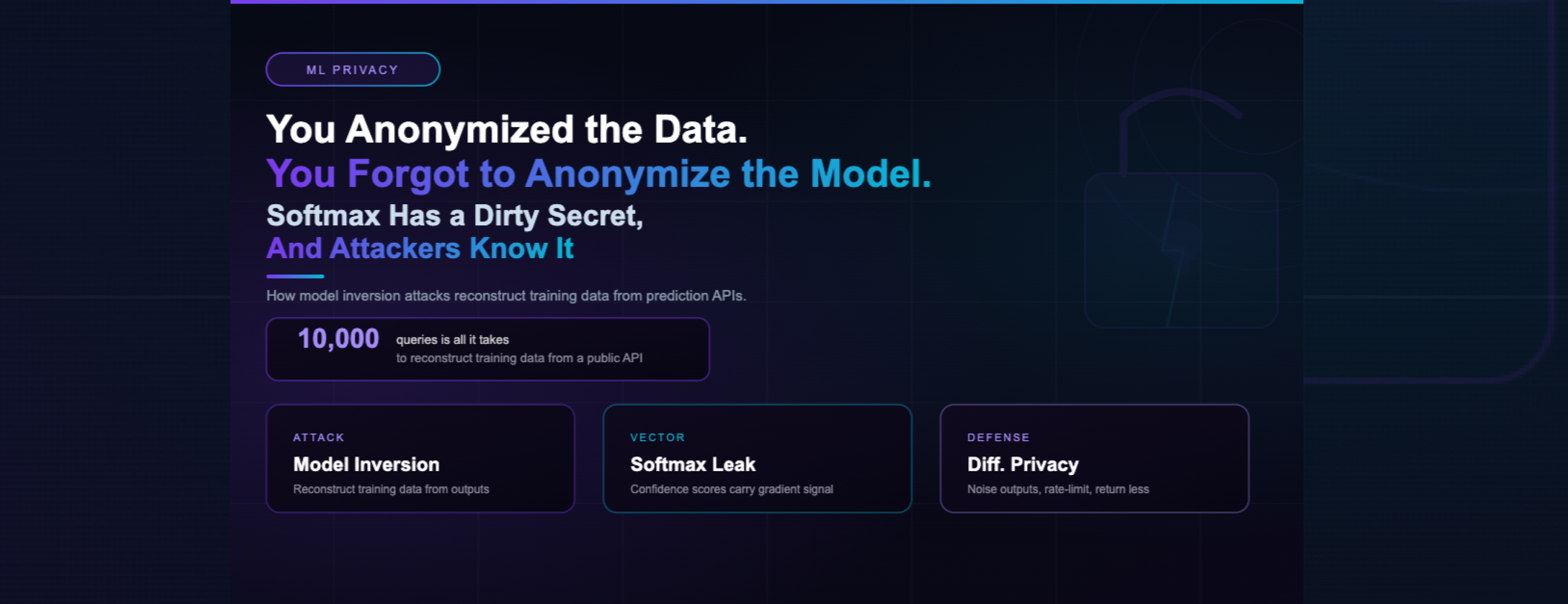
In federated learning and split inference, the output of softmax (or the pre-softmax logits) can leak training data. Given enough model outputs, an attacker can reconstruct training samples through model inversion attacks. Softmax probabilities, because they encode the model's internal confidence geometry, act as a side channel.
This is an active area of research in privacy-preserving ML, and a practical concern for any organization using shared or third-party model APIs.
What Can You Do?
- Replace overconfidence with calibration. Use temperature scaling post-training, Platt scaling, or Bayesian approaches to get probabilities that actually reflect uncertainty. Libraries like netcal make this straightforward.
- Add out-of-distribution detection. Don't rely on softmax confidence as your safety gate. Use dedicated OOD detectors (Mahalanobis distance, energy-based scores, or ensembles) as a separate layer.
- Adversarial training. Include adversarially perturbed examples during training. This raises the cost of gradient-based attacks significantly.
- Monitor logit distributions in production. Anomalous logit patterns — unusually flat or unusually sharp — are often early signals of adversarial probing.
- Don't expose raw logits or full probability vectors to untrusted callers. Return only the top prediction when possible. Full softmax output vectors are richer attack signals than you might assume.
The Bigger Picture
Softmax is not going away. It's foundational to classification, attention, and a dozen other core mechanisms in modern deep learning. But treating its output as ground truth — as a reliable signal of what a model "knows" — is a mistake that attackers actively exploit.
The models you trust most are likely the ones most worth attacking. Understanding their mathematical structure, including the humble softmax, is the first step to defending them.