
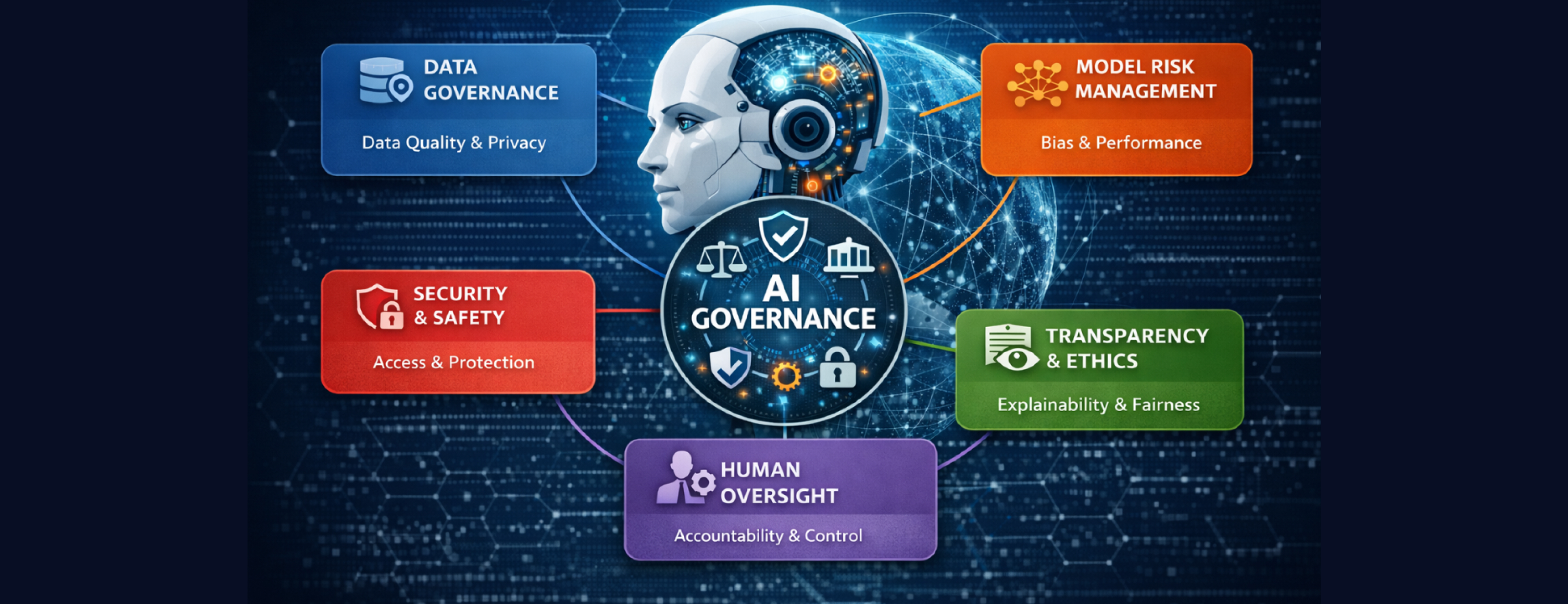
A Structured Approach to Responsible, Secure, and Scalable Artificial Intelligence
Artificial Intelligence (AI) systems are rapidly transitioning from experimental innovation to mission-critical infrastructure across finance, healthcare, automotive, manufacturing, and enterprise SaaS platforms. As AI systems increasingly influence operational decisions and customer interactions, organizations face growing risks related to bias, security vulnerabilities, regulatory compliance, explainability, and model drift.
AI governance provides a structured framework to manage these risks while enabling sustainable innovation. This white paper presents a comprehensive governance model spanning data lifecycle management, model risk oversight, operational monitoring, regulatory alignment, and organizational accountability.
Effective AI governance is not a constraint on innovation; it is an enabler of enterprise-scale deployment.
1. Introduction
AI systems differ fundamentally from traditional software:
- They are probabilistic rather than deterministic.
- They evolve over time through retraining and data drift.
- They rely heavily on large, often opaque datasets.
- They can generate novel outputs not explicitly programmed.
These characteristics introduce systemic risks that require dedicated governance structures. Traditional IT governance and cybersecurity controls are insufficient to address the unique challenges posed by machine learning and generative AI systems.
2. Defining AI Governance
AI governance refers to the policies, controls, technical safeguards, and organizational processes that oversee the full lifecycle of AI systems:
- Data acquisition and preparation
- Model development and training
- Validation and risk assessment
- Deployment and monitoring
- Incident response and continuous improvement
The objective is to ensure AI systems are:
- Ethical
- Secure
- Transparent
- Compliant
- Reliable
- Accountable
3. Risk Landscape
3.1 Regulatory Risk
Emerging regulatory frameworks require demonstrable compliance in areas such as:
- Bias mitigation
- Data protection (e.g., GDPR, CCPA)
- Model explainability
- Risk classification and impact assessments
Non-compliance exposes organizations to financial penalties and operational restrictions.
3.2 Security Risk
AI systems introduce novel attack vectors:
- Prompt injection and adversarial manipulation
- Model inversion attacks
- Data poisoning
- Unauthorized model access
- API exploitation
Without governance, these vulnerabilities scale with model deployment.
3.3 Operational Risk
AI models degrade over time due to:
- Data drift
- Distribution shifts
- Feedback loops
- Concept drift
Unchecked degradation may silently erode decision quality.
3.4 Reputational Risk
AI-generated errors or biased decisions can lead to:
- Public backlash
- Customer attrition
- Brand damage
Trust is a strategic asset; governance protects it.
4. Core Governance Pillars
4.1 Data Governance
Data governance forms the foundation of AI governance.
Key components:
- Data lineage tracking
- Consent and licensing validation
- Personally Identifiable Information (PII) controls
- Secure storage and access management
- Bias detection within datasets
- Synthetic data validation
Without controlled data pipelines, downstream model reliability cannot be assured.
4.2 Model Risk Management
Model risk management ensures that AI outputs are measurable, auditable, and within acceptable thresholds.
Controls include:
- Model documentation (model cards)
- Training dataset documentation
- Performance benchmarking across subpopulations
- Adversarial robustness testing
- Fairness evaluation metrics
- Drift detection and alerting systems
High-impact systems require periodic independent review.
4.3 Security Controls for AI Systems
AI governance must integrate cybersecurity principles specific to AI architectures.
Technical safeguards:
- Input sanitization layers
- Output validation filters
- Rate limiting and abuse detection
- API authentication and authorization controls
- Isolation of model runtime environments
- Audit logging of model interactions
Governance frameworks should integrate with existing DevSecOps pipelines.
4.4 Transparency and Explainability
Explainability is essential for regulatory compliance and stakeholder trust.
Techniques include:
- Feature attribution methods (e.g., SHAP, LIME)
- Confidence scoring
- Decision traceability logging
- Human-readable justification outputs
- Model interpretability documentation
Explainability requirements should align with risk classification levels.
4.5 Human Oversight and Accountability
Clear ownership structures are critical.
Governance frameworks must define:
- Model owners
- Approval authorities
- Monitoring responsibilities
- Incident response leads
- Escalation pathways
Accountability cannot be distributed ambiguously across teams.
5. Operationalizing AI Governance
5.1 Governance Embedded in Development Lifecycle
Governance must be integrated into the Software Development Lifecycle (SDLC):
- Pre-deployment model review gates
- Automated bias checks in CI/CD pipelines
- Security scanning of model APIs
- Compliance documentation before release
Governance should operate as “policy-as-code” where feasible.
5.2 Continuous Monitoring and Observability
AI systems require persistent observability beyond deployment.
Monitoring should include:
- Accuracy degradation metrics
- Data distribution monitoring
- Latency and throughput performance
- Hallucination rate (for generative models)
- Adversarial behavior detection
Real-time telemetry is foundational to proactive governance.
6. Governance Maturity Model
Organizations typically progress through stages:
Level 1: Ad Hoc
- No formal documentation
- Limited monitoring
- Reactive incident response
Level 2: Structured Controls
- Basic documentation
- Initial model reviews
- Some monitoring
Level 3: Integrated Governance
- Governance embedded in SDLC
- Continuous monitoring
- Clear accountability
Level 4: Automated Governance
- Policy-as-code
- Real-time compliance scoring
- Automated drift detection and mitigation
7. Balancing Governance and Innovation
Excessive controls can slow experimentation. Insufficient controls increase systemic risk.
Best practice:
- Risk-tiered governance (higher controls for high-impact systems)
- Sandbox environments for experimentation
- Clear transition criteria from prototype to production
Governance must scale proportionally to system impact.
8. Strategic Recommendations
Organizations implementing AI governance should:
- Establish cross-functional AI oversight committees
- Create standardized model documentation templates
- Implement AI-specific security controls
- Develop continuous model monitoring pipelines
- Align governance policies with regulatory trends
- Train engineering teams on responsible AI principles
Governance is most effective when aligned with executive sponsorship and technical execution.
9. Conclusion
AI systems are becoming foundational to enterprise operations. Their probabilistic nature introduces risks not addressed by traditional IT governance frameworks.
AI governance provides the structural discipline required to:
- Reduce systemic risk
- Ensure regulatory compliance
- Protect brand integrity
- Enable responsible innovation
Organizations that institutionalize AI governance as a strategic capability will achieve sustainable competitive advantage in the era of intelligent systems.